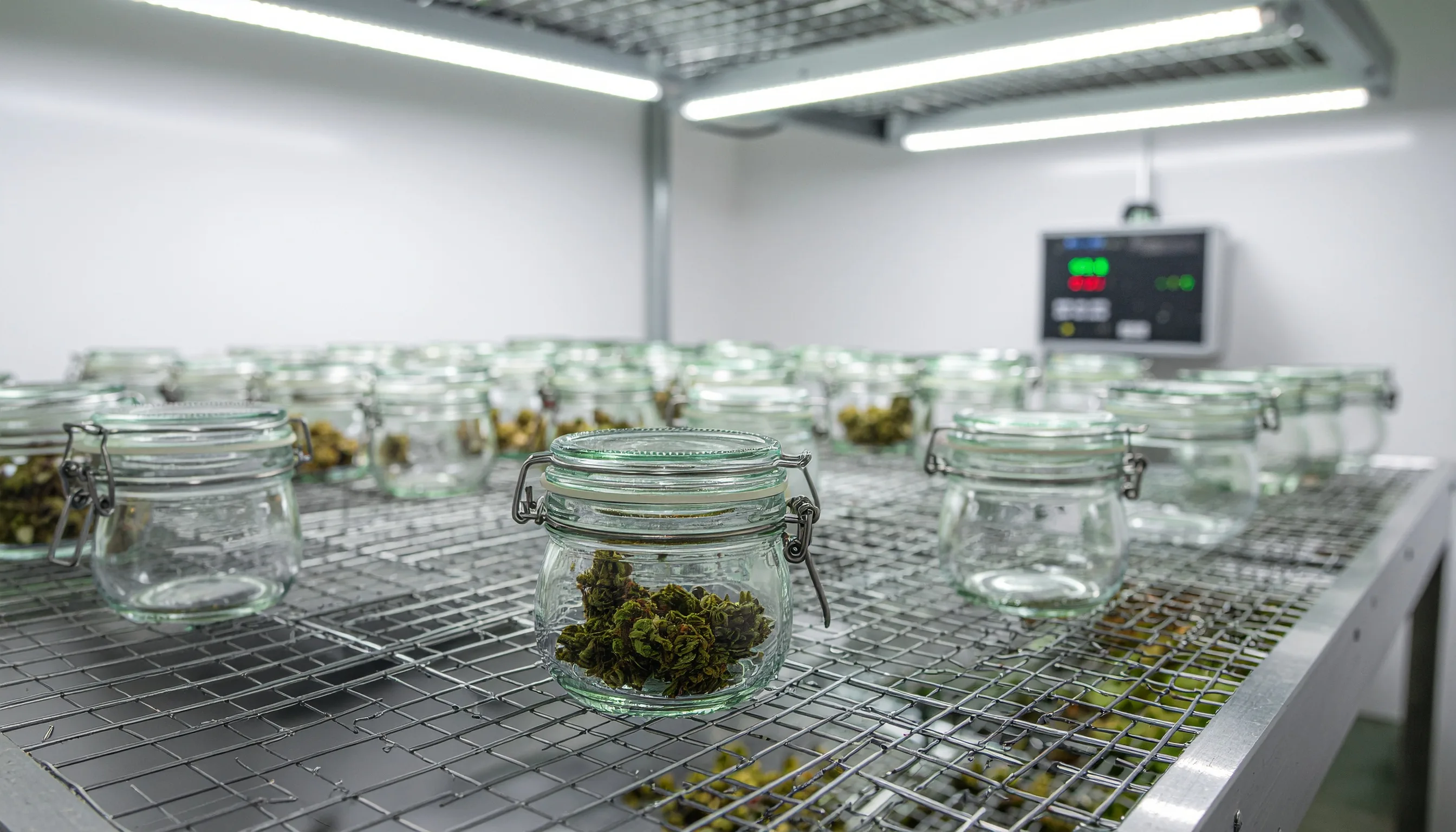
Why post-harvest matters as much as cultivation
A flower that tests at 12% Δ9-THC, 4% CBD, and a balanced terpene profile on the day of harvest is not necessarily what arrives in a pharmacy three months later. Between the cultivation room and the dispensing counter sits a series of decisions — how the flower is dried, how long and how it's cured, how it's trimmed, how it's packaged — that determine what the patient actually receives.
Most cultivators will talk eagerly about cultivation. Far fewer will document their post-harvest protocols in detail. For a licensed importer, this is the part of the supply chain where the most quiet quality erosion happens — and it's the part the patient experiences most directly.
This piece is for procurement professionals at licensed importers who want to know what to ask for in a post-harvest spec, and for clinical readers who want to understand how the chemistry on a CoA actually got there.
Drying — the first and most under-documented decision
When cannabis flower is harvested, it contains roughly 70–75% water. To become a stable product, it needs to come down to 10–12% water (target moisture content for inhaled flower; lower for extracts).
How fast the flower loses that water — and under what environmental conditions — has compound effects on the final chemistry:
Slow, controlled drying (10–14 days at 18–21°C, 55–60% RH) This is the gold standard. Environmental controls maintain a slow water-loss curve that lets the plant finish its post-harvest chemistry — chlorophyll degrades, simple sugars convert to longer-chain compounds (the "cure"), and terpenes remain volatile-locked inside trichome heads rather than evaporating. Result: a flower whose cannabinoid and terpene profile closely matches the harvest assay.
Fast, hot drying (3–5 days at >25°C) Sometimes done to compress production schedule. Outcomes: 20–40% terpene loss (the most volatile terpenes evaporate first — limonene, pinene, ocimene), trichome capitation (some heads burst from the rapid moisture migration), accelerated chlorophyll-related off-notes that persist into the cure. The cannabinoid profile measured at packaging will be substantially different from what was harvested.
Slow, uncontrolled drying (>14 days, ambient humidity) The opposite failure: drying so slow that microbial growth becomes a risk. Mould (Aspergillus, Penicillium) and yeast colonisation peak in the 14–21 day window if humidity isn't actively controlled. The flower can pass cannabinoid testing but fail microbial limits.
The honest summary: drying environment and drying speed are clinical decisions. Imported medical-cannabis specifications should require documented drying SOPs with environmental logs — temperature and humidity recorded at intervals across the drying period, retained as part of the batch record.
Curing — finishing the chemistry
After initial drying, the flower enters the cure: a longer (14–28 day) period in sealed but periodically opened containers ("burping") at controlled temperature and humidity. This is where:
- Residual moisture redistributes evenly through the flower
- Terpenes re-equilibrate and bond more strongly to trichome resin
- The remaining chlorophyll completes its degradation
- The flower achieves shelf-stable equilibrium
A flower that wasn't properly cured will continue to evolve in storage — cannabinoid drift, terpene shift, mouth-feel changes — none of them desirable for clinical reproducibility.
Required cure documentation:
- Cure room environmental logs (temperature, RH, intervals)
- Burping schedule
- Container type and sealing protocol
- Pre-cure and post-cure moisture content measurements
- Pre-cure and post-cure cannabinoid assay (some operations test both points to verify drift is within tolerance)
For a German or Israeli importer, the cure-stage documentation is non-negotiable. For an Australian importer it's increasingly expected.
Trim — mechanical handling matters
After cure, the flower is trimmed: leaves removed, stems separated, individual buds prepared for packaging. This is a mechanical-handling stage and the relevant quality variable is trichome preservation.
Trichomes are the resin glands that hold most of the cannabinoid and terpene content. They are physically delicate — too much vibration or rough handling knocks them off the flower. Lost trichomes are lost dose. A flower that loses 5% of its trichomes in trim has effectively lost 5% of its labelled potency.
Two trim approaches:
Hand trim — the gold standard for medical-grade. Slow, expensive, and deeply trichome-preserving. The flower is trimmed by people working under controlled-environment conditions (clean-room gloves, hairnets, environmental controls).
Machine trim — faster, cheaper, and harder on trichomes. Suitable for extract-bound material where downstream processing recovers trichomes from the trim debris. Not generally suitable for flower SKUs destined for direct patient dispensing.
Imported medical-cannabis spec should explicitly state which trim method is used, in which environment, with what hygiene controls. Often a contract will specify "hand trim under controlled-environment conditions" as a minimum.
Packaging — where contamination risk and stability converge
Packaging is the last quality gate before the flower leaves the manufacturer. Two requirements:
Environmental control during packaging The packaging room should be at the same controlled conditions as the cure room (18–21°C, 55–60% RH) at minimum, and ideally HEPA-filtered to particulate counts compatible with EU-GMP grade D or better. Packaging in an uncontrolled environment can re-introduce moisture, microbes, or particulate contamination.
Packaging materials The retail-unit packaging must be:
- Light-tight (foil-lined, opaque) — UV degrades terpenes and oxidises THC
- Oxygen-barrier (typically nitrogen-flushed at sealing) — oxygen oxidises THC to CBN
- Humidity-controlled (calibrated humidity packs at 58–62% RH inside)
- Tamper-evident — required for medical-channel dispensing
A bulk shipment packed properly in retail units arrives at the importer in dispensing-ready form. A bulk shipment packed without these controls requires repackaging at destination, with all the contamination and exposure risks that entails.
What licensed importers should specify in the supply contract
A robust post-harvest spec in a medical-cannabis supply agreement reads:
- Drying protocol — temperature range, humidity range, duration range, environmental log retention.
- Cure protocol — duration, container, burping schedule, pre/post moisture and cannabinoid measurements.
- Trim method — explicit (hand trim, machine trim, or hybrid), with environmental conditions during trim.
- Packaging environment — clean-room grade, HEPA filtration if applicable, environmental log retention.
- Packaging materials — light-tight, oxygen-barrier, humidity-controlled, tamper-evident, with material specifications.
- Documentation pack delivery — all of the above logs delivered with each batch as part of the standard documentation pack.
This is what we deliver under our standard supply terms and what serious German, Israeli, and Australian importers expect.
What patients actually receive
A patient prescribed CBD-dominant flower in Munich, Tel Aviv, or Brisbane next month is, at the molecular level, receiving the result of decisions made about drying speed three months ago, cure duration two months ago, and packaging environment one month ago. She doesn't see any of this. What she experiences is whether her medication tastes like her medication, smells like her medication, and behaves like her medication did the previous month.
That experience is downstream of post-harvest decisions. Most cultivators don't document them. The medical-grade ones do.
How CannaBless documents post-harvest
Every CannaBless export ships with:
- Drying SOP and environmental log for the batch
- Cure SOP, burping schedule, and pre/post cannabinoid measurements
- Trim method declaration and clean-room environmental record
- Packaging room environmental record (temperature, humidity, particulate)
- Packaging material specifications and lot numbers
- Tamper-evident seal verification at retail-unit level
If you're a licensed importer evaluating Thai supply, ask for the post-harvest section of the documentation pack. The completeness of it is a reliable signal of how the rest of the supply chain operates. Patients depend on every minute of those three months between harvest and dispensing being deliberate.